

Postpartum OCD for Moms: What to Know and Do
If you’re having terrifying thoughts about your baby that you can’t shake, you may be experiencing postpartum OCD, a treatable form of obsessive-compulsive disorder that can start or worsen after childbirth, according to Cleveland Clinic and Cedars-Sinai. Having these thoughts does not make you dangerous. It makes you human.
Safety check first: If you have a specific plan to harm yourself or your baby, or you feel unable to keep your baby safe right now, call 911 or go to your nearest emergency room immediately.
If that’s not where you are, keep reading. You’re in the right place.
- Intrusive thoughts occur in up to 80% of the general population and are especially common in new parents.
- Having a thought is not the same as having an intention.
- Being horrified by the thought is actually a protective sign, not a red flag.
Table of Contents
- What is postpartum OCD, and how is it different from postpartum depression?
- What do postpartum OCD symptoms actually look like?
- When should you seek help immediately?
- What treatments actually work for postpartum OCD?
- Day-to-day coping while you arrange care
- How do you talk to your doctor about this?
- Where to find help in the United States
- Key Takeaways
- A note from Sarah at Momcreativeblogger
- Useful sources and further reading
What is postpartum OCD, and how is it different from postpartum depression?
Postpartum OCD (also called perinatal OCD when it includes pregnancy) follows the same diagnostic criteria as OCD but is triggered or worsened by the hormonal and psychological upheaval of childbirth. The IOCDF describes it as a cycle of obsessions (unwanted intrusive thoughts) and compulsions (behaviors or mental rituals meant to neutralize them), almost always focused on the newborn.

The key word is ego-dystonic: the thoughts feel completely foreign and deeply wrong to you. That’s what separates postpartum OCD from postpartum psychosis, where a person loses touch with reality and may not recognize their thoughts as harmful. Cedars-Sinai is clear that perinatal OCD is an outpatient condition in most cases, while psychosis requires emergency inpatient care.
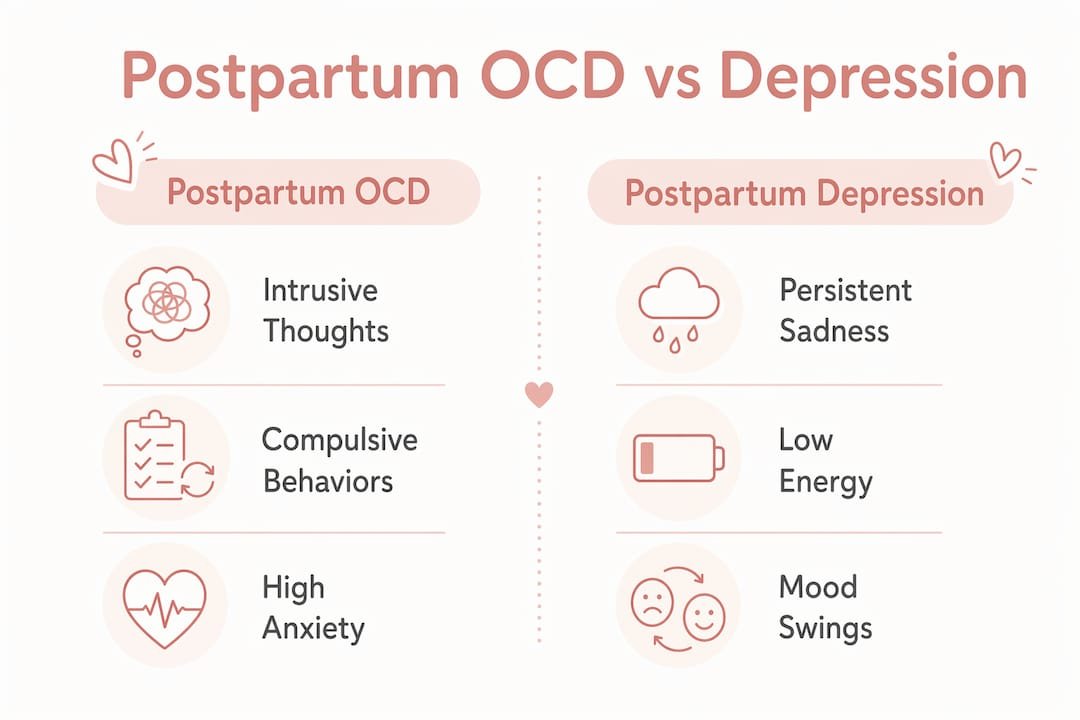
How it differs from postpartum depression and anxiety:
- Postpartum depression centers on persistent sadness, hopelessness, and loss of interest. OCD can co-occur with depression, but the defining feature of OCD is the obsession-compulsion loop, not low mood.
- Postpartum anxiety feels like a constant background hum of “what if” worry. OCD involves specific, vivid, “sticky” images or impulses, plus rituals to manage them.
- Postpartum OCD is driven by intrusive thoughts you find horrifying, followed by compulsions you feel compelled to perform.
Risk factors include a prior history of OCD or anxiety, being a first-time parent, sleep deprivation and chronic stress, and rapid hormonal shifts after delivery. Texas Children’s Pavilion for Women notes that many women are more likely to experience mood and anxiety symptoms when hormone levels shift rapidly after birth.
What do postpartum OCD symptoms actually look like?
The core PPOCD symptoms fall into a few recognizable patterns. Most parents don’t recognize them as OCD because they look like “being careful.”
Common intrusive thoughts and obsessions:
- Fear of accidentally dropping or hurting the baby
- Horrifying images of deliberately harming the baby (these are ego-dystonic, meaning you don’t want them)
- Fear of contamination or germs reaching the baby
- Unwanted sexual obsessions involving the baby
Compulsions and rituals that follow:
- Checking the baby’s breathing repeatedly through the night, far beyond what feels reasonable
- Sterilizing bottles or washing clothes multiple times
- Avoiding bathing the baby, using stairs, or holding the baby near windows
- Constantly seeking reassurance from a partner (“Is the baby okay? Am I a bad mom?”)
- Mental rituals like praying, counting, or replaying scenarios to “undo” the thought
The difference between normal new-parent checking and compulsive checking is disruption. If checking consumes significant time, interferes with sleep or bonding, or leaves you more anxious rather than relieved, that’s the OCD cycle at work. Untreated, PPOCD can strain relationships and make caring for your baby feel impossible.
When should you seek help immediately?
Most parents with postpartum OCD need outpatient care, not emergency intervention. But some situations require urgent action.
Call 911 or go to the ER right now if:
- You have a specific plan to harm yourself or your baby
- You are hearing voices telling you to harm your baby
- You feel unable to keep your baby safe in this moment
Contact a clinician the same day if:
- Intrusive thoughts are occurring constantly and you can’t function
- You’ve stopped caring for your baby out of fear
- You’re experiencing severe depression alongside the obsessions
Practical interim safety steps:
- Ask a trusted person to stay with you
- Remove access to items that trigger the thoughts (knives, stairs) temporarily
- Keep the Postpartum Support International helpline number handy: 1-800-944-4773
- Save the 988 Suicide and Crisis Lifeline in your phone
One thing that stops many parents from calling: fear that disclosing intrusive thoughts will trigger a child protective services investigation or hospitalization. Clinicians at ADAA are clear that intrusive thoughts in OCD are recognized as ego-dystonic, not evidence of intent. Disclosing them leads to treatment, not punishment. Telling your provider is the single most protective thing you can do.
What treatments actually work for postpartum OCD?
The gold-standard treatments are Cognitive Behavioral Therapy with Exposure and Response Prevention (ERP) and SSRIs, used alone or together for moderate-to-severe cases. Texas Children’s Pavilion for Women reports that most women respond to ERP within several weekly sessions.
Why ERP is different from regular talk therapy: General supportive therapy helps you process feelings. ERP specifically targets the obsession-compulsion loop by gradually exposing you to the feared thought or situation while preventing the compulsive response. Over time, your brain learns the thought isn’t actually dangerous. IOCDF emphasizes that ERP must be delivered by a clinician trained in the technique, not just any therapist.
| Treatment | What it involves | Breastfeeding note |
|---|---|---|
| ERP (CBT) | Gradual exposure to feared thoughts; blocking compulsive responses | No medication involved; safe during breastfeeding |
| SSRIs | Sertraline, fluoxetine, and others; first-line medication for OCD | Small amounts pass into breast milk; discuss risks and benefits with your prescriber |
| Combined ERP + SSRI | Most effective for moderate-to-severe cases | Prescriber weighs individual risk profile |
On breastfeeding: SSRIs are commonly used and clinical consensus holds that many are compatible with breastfeeding, but the decision should be made collaboratively with your prescriber based on your specific situation. The Royal College of Psychiatrists notes that perinatal OCD is highly treatable and that waiting for symptoms to resolve on their own is not recommended.
Cedars-Sinai clinicians suggest scheduling 4–5 sessions with a therapist before deciding on fit. If a therapist isn’t using ERP techniques for your OCD symptoms, it’s okay to keep looking.
Day-to-day coping while you arrange care
These steps won’t replace treatment, but they can reduce suffering while you get there.
- Set a checking window. Instead of checking the baby’s breathing every few minutes, agree on a set interval (say, every 20 minutes). This limits the compulsion without cold-turkey avoidance.
- Limit reassurance cycles. Repeated reassurance provides only temporary relief and strengthens the compulsion loop. Agree with your partner on a daily limit.
- Use a code phrase with your partner. Something simple like “I’m in the loop” signals you need support without triggering a full reassurance conversation.
- Try grounding when a thought hits. Name five things you can see. It interrupts the spiral without feeding the compulsion.
- Protect sleep in whatever small ways you can. Even one longer sleep block reduces OCD severity. Check out realistic self-care ideas for busy moms for zero-free-time options.
- Keep a short “what I did instead” log. Note each time you resisted a compulsion and what you did instead. It builds evidence that you can tolerate the anxiety, and it de-fuels guilt over time.
Pro Tip: If you’re spiraling in guilt about your thoughts, read through Momcreativeblogger’s piece on feeling like you’re failing your kids. Shame is OCD’s fuel. Naming it takes some of that power away.
How do you talk to your doctor about this?
You don’t need a perfect script. You just need to start.
Two ways to open the conversation:
- Clinical: “I’ve been having intrusive, unwanted thoughts about my baby’s safety that I can’t control. I think I may have postpartum OCD and I’d like a referral for ERP therapy.”
- Plain language: “I keep having scary thoughts I don’t want. They’re not going away and they’re affecting my ability to function. Can you help me figure out what’s going on?”
What to bring to the appointment:
- A brief log of how often thoughts occur and how long compulsions take
- Your medication history and breastfeeding status
- A list of questions
Questions worth asking:
- Does this sound like postpartum OCD to you?
- Can you refer me to a therapist trained in ERP for perinatal OCD?
- What are my medication options given that I’m breastfeeding?
- Is teletherapy an option if I can’t get childcare for in-person sessions?
For insurance, ask specifically about “out-of-network mental health benefits” and “sliding-scale fees.” University training clinics and community mental health centers often offer ERP at reduced cost.
Where to find help in the United States
- Postpartum Support International (PSI): Call 1-800-944-4773 or text “HELP” to 971-203-7773. PSI maintains a referral directory of perinatal mental health specialists and local support groups.
- IOCDF Perinatal OCD Resource Center: Visit iocdf.org/perinatal-ocd for clinician directories and treatment guides specific to perinatal OCD.
- ADAA Provider Directory: adaa.org connects you to anxiety and OCD specialists who accept insurance.
- 988 Suicide and Crisis Lifeline: Call or text 988 for immediate crisis support.
- American Psychiatric Association (APA): apa.org offers patient education and a psychiatrist finder for medication management.
Search terms that find the right clinicians faster: “perinatal OCD therapist,” “ERP for postpartum OCD,” “reproductive psychiatrist near me.” When vetting a therapist, ask directly: “Do you use Exposure and Response Prevention for OCD?” A yes with a clear explanation of the technique is what you’re looking for.
For peer connection and community support, Momcreativeblogger’s motherhood anxiety resources and community pages are a good starting point while you arrange clinical care.
Key Takeaways
Postpartum OCD is a treatable condition, and getting help early, before symptoms deepen, is the single most effective thing you can do.
| Point | Details |
|---|---|
| Intrusive thoughts are common | Clinical guidance notes they occur in up to 80% of the general population and are especially common in new parents; being disturbed by them is a protective sign, not evidence of intent. |
| OCD differs from psychosis | Postpartum OCD is ego-dystonic and outpatient-treated; postpartum psychosis involves delusions and requires emergency care. |
| ERP is the gold standard | Exposure and Response Prevention, delivered by a trained clinician, is the most effective therapy for postpartum OCD. |
| Disclosure is safe | Telling your provider about intrusive thoughts leads to treatment, not child protective involvement. |
| Recovery is realistic | With ERP and/or SSRIs, most women respond within weeks; waiting for symptoms to pass on their own is not recommended. |
A note from Sarah at Momcreativeblogger
I know how isolating it feels to carry thoughts you’re too scared to say out loud. The shame of it can make you feel like you’re the only one, like something is fundamentally broken in you. You’re not broken. You’re a parent whose brain is working overtime to protect someone you love, and that mechanism has gotten stuck.
Momcreativeblogger exists because motherhood is hard in ways nobody warns you about. If you’re in the thick of this right now, please reach out to a provider today. And while you’re arranging care, come back here. Browse the mental load and motherhood resources, grab a free printable, or just read something that reminds you you’re not alone. You deserve support, and you deserve to get better.
This article is general information, not clinical advice. Please confirm current treatment guidelines and crisis resources with a qualified mental health professional for your specific situation.
Useful sources and further reading
| Source | Why it’s worth reading |
|---|---|
| Cleveland Clinic: Postpartum OCD | Clear clinical overview of symptoms, prevalence, and the ego-dystonic nature of intrusive thoughts |
| Cedars-Sinai: Postpartum Anxiety, OCD, and Psychosis | Explains the critical distinction between OCD and psychosis; guides on ERP and disclosure |
| IOCDF Perinatal OCD Resource Center | Comprehensive treatment guides and clinician directories specific to perinatal OCD |
| ADAA: Unexpected OCD (Postpartum) | Addresses disclosure fears and explains why telling your provider is safe |
| Texas Children’s Pavilion for Women | Practical treatment pathway including SSRIs, ERP session counts, and breastfeeding guidance |
| Royal College of Psychiatrists: Perinatal OCD | Clinical guidance on treatment, medication, and why waiting for symptoms to resolve is not advised |
| Beyond OCD: PPOCD | Patient-facing overview of symptoms, relationship impact, and treatment options |
- For crisis support: Postpartum Support International (1-800-944-4773) and the 988 Suicide and Crisis Lifeline are available 24/7.
- For clinicians: The IOCDF Perinatal OCD Resource Center includes prescribing guidance and breastfeeding references for perinatal OCD medication management.
- For further reading on perinatal mental health: Search PubMed for peer-reviewed studies on perinatal OCD prevalence and ERP outcomes.