

How to Get a Breast Pump Through Insurance for Free
Most pregnant and nursing women in the U.S. qualify for a breast pump through insurance at little to no out-of-pocket cost, and the fastest path is simpler than it sounds: verify your benefits, get a prescription from your prenatal provider, and order through a direct-billing durable medical equipment (DME) supplier. Under the Affordable Care Act, most ACA-compliant private and employer plans must cover breastfeeding equipment as a preventive service, which usually means $0 out of pocket for you.
Here’s your quick action checklist to get started:
- Log into your member portal or call the member services number on your insurance card and ask specifically about breast pump coverage and DME requirements.
- Ask your OB, midwife, or primary care provider for a prescription for a double electric breast pump (ideally in your third trimester).
- Check whether prior authorization is needed before you place any order.
- Choose a direct-billing DME supplier (like Aeroflow Breastpumps, Optum Store, or Yummy Mummy Store) and use their online pre-verification tool to confirm your covered model.
- Place your order and confirm the delivery timeline with the supplier.
Medicaid coverage varies by state and may require additional steps. Medicare does not cover breast pumps at all. Keep reading for the full breakdown by plan type, supplier options, and what to do if your claim gets denied.
Table of Contents
- Does your insurance plan cover a breast pump?
- What pump types does insurance typically cover?
- Who qualifies and what proof do you need?
- Step-by-step: how to get a breast pump through insurance
- How national suppliers that bill insurance work
- What triggers out-of-pocket costs and common exceptions
- Why Medicaid coverage varies by state and how to check yours
- What to do if your coverage is denied
- Your printable checklist, phone scripts, and sample physician letter
- Key Takeaways
- Navigating the insurance process is honestly a lot
- Momcreativeblogger has the resources to help you prep
- Useful sources
Does your insurance plan cover a breast pump?
The short answer for most moms: yes, if you have an ACA-compliant plan. But the details depend on which type of coverage you have, and a few plan categories work very differently.
| Plan Type | Coverage | Typical Pump Types Covered | Billing Method |
|---|---|---|---|
| ACA marketplace / ACA-compliant employer plan | Yes (required) | Manual, single/double electric; sometimes wearable | Direct-bill through in-network DME supplier |
| Employer plan (grandfathered) | Varies | Varies by plan | Varies; may require reimbursement |
| Medicaid | Varies by state | Manual or standard electric most common | State-managed; often direct-bill through approved supplier |
| TRICARE | Yes | Standard electric | Direct-bill through authorized supplier |
| Medicare | No | N/A | Not covered |
The ACA sets the baseline. Under federal law, non-grandfathered ACA-compliant plans must cover breastfeeding support and equipment as a preventive service, with no cost-sharing for the member. That means no copay, no deductible applied, and no coinsurance, as long as you follow your plan’s rules (in-network supplier, covered model, required documentation).
Grandfathered plans, which existed before March 23, 2010 and haven’t made significant changes since, are exempt from this preventive-services requirement. If you’re on one of those, your coverage depends entirely on your plan’s own benefit language. Medicare excludes breast pumps entirely, unlike ACA marketplace plans and most Medicaid programs.
A few other common plan rules that can change your outcome:
- One pump per birth: Most plans limit coverage to one pump per delivery, not per year.
- Rental vs. purchase: Personal-use pumps are typically yours to keep; hospital-grade pumps are usually rented and require a separate medical justification.
- Replacement parts: Flanges, tubing, and valves may be reimbursed differently than the pump itself, sometimes under a separate benefit.
- Medicaid state variation: Eligibility rules, covered pump types, and prior authorization requirements differ significantly from state to state.
Pro Tip: Before you order anything, confirm your benefits directly. Log into your member portal or call the number on your insurance card and ask: “Does my plan cover a breast pump as a preventive benefit? Do I need prior authorization? Which DME suppliers are in-network?”

What pump types does insurance typically cover?
Most plans cover a standard double electric pump at no cost. Beyond that, coverage gets more plan-specific, and choosing the wrong model can mean paying out of pocket for the difference.
Here’s what you’ll commonly see covered:
- Manual pumps: Covered by most plans, though many moms find a double electric far more practical for regular pumping.
- Single electric pumps: Covered by most ACA-compliant plans; useful for occasional pumping.
- Double electric pumps: The most commonly covered and most requested type. This is the category most plans default to when you ask for a “standard covered pump.”
- Wearable pumps (like hands-free models): Sometimes covered, but often classified as a premium upgrade. Your plan may cover the base cost of a standard pump and ask you to pay the difference.
- Hospital-grade pumps: Generally available as rentals only, not for purchase, and require prior authorization for medical necessity. These are typically reserved for NICU situations, premature births, or documented feeding challenges.
The key concept here is the plan formulary. Just like prescription drugs, many insurers maintain a list of approved pump models. Choosing a pump outside that list, or upgrading to a higher-end wearable, usually triggers an upgrade fee where you pay the difference between the plan’s covered amount and the retail price of the model you want.
Pro Tip: Before you fall in love with a specific pump model, ask your DME supplier or insurer: “Which E-code or model does my plan cover at no cost?” That one question can save you $50–$200 in upgrade fees.
Who qualifies and what proof do you need?
Eligibility is pretty straightforward for most moms. If you’re pregnant or currently nursing and enrolled in an ACA-compliant plan, you qualify for breast pump coverage as a preventive benefit. The ACA’s preventive services requirement applies specifically to pregnant and nursing women.
Common documentation insurers and suppliers request:
- Prescription from a licensed provider: Your OB, midwife, or family doctor can write this. It typically specifies “double electric breast pump” and your due date or delivery date.
- Estimated due date or newborn documentation: Some plans require proof of pregnancy before birth; others process the order postpartum.
- Insurance ID card: Your supplier needs your member ID, group number, and plan name to verify and bill your insurer.
A few special situations worth knowing about:
- NICU stays: If your baby is in the NICU, you may qualify for a hospital-grade rental under medical necessity. Your provider will need to document this specifically.
- Medical challenges: Conditions like inverted nipples, low milk supply, or latch difficulties can support a medical-necessity claim for a hospital-grade rental or a specific pump model.
- Adoption: Coverage for adoptive mothers who plan to induce lactation varies by plan. Call your insurer directly to ask whether the preventive benefit applies to your situation.
Prior authorization is commonly required for hospital-grade rentals and sometimes for standard pumps depending on your plan. If your plan requires it, your provider or DME supplier typically handles the submission, but you need to initiate the process before ordering. Skipping this step is one of the most common reasons orders get delayed or denied.
Step-by-step: how to get a breast pump through insurance
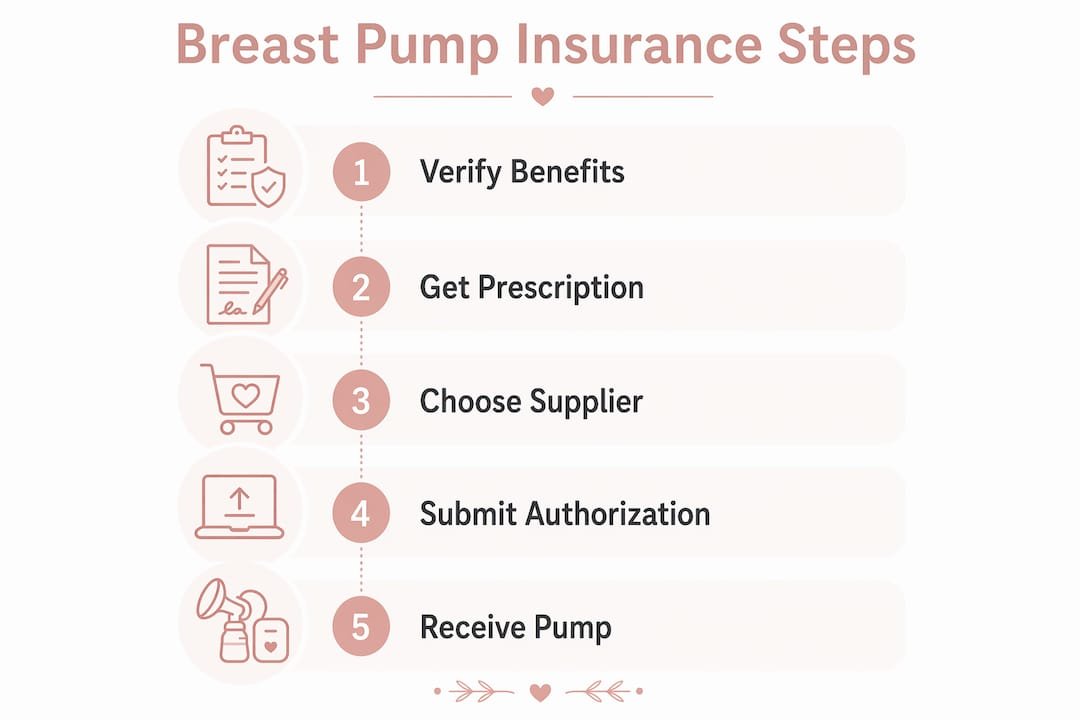
This is the process that works for most moms on ACA-compliant plans. Follow it in order and you’ll avoid the most common delays.
Verify your benefits. Log into your member portal or call member services. Ask specifically: “Does my plan cover a breast pump? Is it covered as a preventive benefit with no cost-sharing? Do I need prior authorization? Which DME suppliers are in-network?” Write down the rep’s name and the date of the call.
Check DME rules. Many insurers classify breast pumps as durable medical equipment, which means you must order through an in-network DME supplier for full coverage. Buying from a retail store and seeking reimbursement is possible but slower and sometimes results in partial payment only.
Get a prescription. Ask your OB, midwife, or primary care provider to write a prescription for a double electric breast pump. The ideal timing is your third trimester, so the pump arrives before or right after your due date. Some plans accept a postpartum prescription, but ordering early gives you more flexibility.
Check for prior authorization. If your plan or supplier flags this requirement, your provider or the DME supplier usually submits the prior auth request. Confirm it’s been submitted and ask for a reference number.
Choose a direct-billing DME supplier. Suppliers like Aeroflow Breastpumps, Optum Store (also known as Optum Now), and Yummy Mummy Store verify your benefits, handle prior authorization paperwork, and bill your insurer directly. Many offer online pre-verification tools that confirm your covered model in minutes.
Place your order and confirm the timeline. Once your benefits are verified and your prescription is on file, the supplier processes the order. Typical timelines: benefit verification takes a few days, prior authorization (if needed) adds additional business days, and delivery usually arrives within about a week or two after approval.
Keep records. Save your prescription copy, the benefit verification confirmation, any prior auth reference numbers, and your order confirmation. You’ll need these if anything goes sideways.
Pro Tip: When you call your insurer, use this script: “I’m pregnant and would like to confirm my breast pump benefit. Is it covered as a preventive service with no cost-sharing? Do I need a prescription or prior authorization? Can you give me a list of in-network DME suppliers?” Short, specific, and it gets you the answers you actually need.
For more time-saving tricks on managing the early weeks of motherhood, the new parent tips at Momcreativeblogger are worth bookmarking.
How national suppliers that bill insurance work
The easiest route for most moms is a national DME supplier that handles the insurance paperwork for you. Here’s how the main models work and what to expect from each.

Direct-billing DME suppliers are companies that verify your benefits, collect your prescription, submit prior authorization if needed, and bill your insurer directly. You typically pay nothing upfront (assuming your plan covers the pump at no cost-sharing). Aeroflow Breastpumps, Optum Store, and Yummy Mummy Store all operate this way. The tradeoff is that your model selection is limited to what the supplier stocks and what your plan’s formulary covers.
Retail vendors with benefit verification let you shop a wider selection and will verify your benefits before checkout. You may still need to pay upfront and seek reimbursement, depending on your plan’s rules.
Hospital-supplied rentals are arranged through the hospital or a hospital-affiliated DME supplier, usually for NICU or medical-necessity situations. These follow a different billing path and almost always require prior authorization.
Pros of using a national direct-bill supplier:
- No upfront cost in most cases
- Paperwork (prior auth, claims) handled for you
- Pre-verification tools confirm your covered model quickly, sometimes in under 60 seconds
- Faster than navigating insurer portals yourself
Cons to know going in:
- Model selection is limited to the supplier’s inventory and your plan’s formulary
- Upgrade fees apply if you want a premium model
- Processing times vary; ordering in the third trimester gives you the most buffer
What triggers out-of-pocket costs and common exceptions
For most moms on ACA-compliant plans, the pump is fully covered. But a handful of situations can put costs back on your plate, and knowing them in advance means no surprises.
Common out-of-pocket triggers:
- Deductible: If your plan applies the deductible to DME (some do, even for preventive benefits), you’ll pay until it’s met. Confirm this specifically when you verify benefits.
- Upgrade fees: Choosing a wearable or premium model outside your plan’s standard formulary means paying the difference. This can range from $30 to over $150 depending on the model.
- Non-covered pump types: Some plans exclude wearable pumps entirely or only cover manual pumps. Know your plan’s formulary before you order.
- Grandfathered plans: These aren’t required to cover pumps at all. If you’re on one, your benefit (if any) is whatever the plan document says.
- Non-participating suppliers: Ordering from a supplier outside your insurer’s network can result in partial reimbursement or a full denial.
- One-per-birth limits: Most plans cover one pump per delivery. If you already received a covered pump in a previous pregnancy and it’s within the same plan year, you may not qualify for another.
A quick example of how this plays out: a mom on an ACA marketplace plan with no deductible applied to preventive services orders a standard double electric through an in-network DME supplier and pays $0. A mom on an employer plan with a $1,500 deductible that applies to DME might pay the full retail cost of the pump until her deductible is met.
Hospital-grade rentals sit in their own category. They’re covered when medically necessary, but require prior authorization and a documented clinical reason. Rental periods and costs vary by plan.
Pro Tip: Before you finalize any order, ask the supplier for a written cost estimate that itemizes the pump cost, any upgrade fee, and shipping charges. A good supplier will provide this before processing your order.
Why Medicaid coverage varies by state and how to check yours
Medicaid is a federal-state partnership, which means the rules for breast pump coverage are set at the state level. What’s covered in California may look completely different from what’s available in Texas or Ohio.
State Medicaid programs can differ on: which pump types are covered (manual only vs. electric), whether a prescription or prior authorization is required, whether coverage is available during pregnancy or only postpartum, and whether NICU or medical-necessity criteria must be met.
How to check your state’s Medicaid policy:
- Call your state Medicaid office. The number is on your Medicaid card or on your state’s Medicaid website. Ask specifically about breast pump coverage, required documentation, and approved suppliers.
- Search your state Medicaid website for “durable medical equipment” or “breastfeeding benefits.” Many states post their coverage policies and approved supplier lists online.
- Contact your local WIC clinic. WIC (Women, Infants, and Children) is a separate federal program that sometimes provides pumps or referrals when Medicaid coverage is limited. WIC staff are often the fastest source of local guidance on what’s available in your area.
A few common state-level restrictions to watch for:
- Coverage may only begin after the baby is born, not during pregnancy.
- Some states require a documented medical condition or NICU stay for electric pump coverage.
- Approved supplier lists may be shorter than what’s available for private insurance.
If your state Medicaid program doesn’t cover the pump you need, WIC is worth a call before you pay out of pocket.
What to do if your coverage is denied
A denial isn’t the end of the road. Most insurers have a formal appeals process, and a well-documented appeal often reverses the decision, especially when a physician letter is involved.
Your appeal checklist:
- Document every call: date, rep name, reference number, and what was said.
- Request a written denial letter from your insurer. It must state the specific reason for denial.
- Keep copies of your prescription, prior authorization submission, and benefit verification confirmation.
- Note your insurer’s appeal deadline (usually 30–180 days from the denial date, depending on your plan).
- Submit your appeal in writing with all supporting documents attached.
What to include in a physician letter for medical necessity:
- Patient name, date of birth, and insurance ID
- Clinical reason for the pump (NICU stay, feeding challenges, inverted nipples, low supply, return to work)
- Specific pump type requested and why it’s medically appropriate
- Provider’s name, NPI number, signature, and date
- Reference to any clinical notes or visit dates that support the claim
A focused physician letter that cites specific clinical reasons often prompts reversals on appeal. Ask your provider to be specific rather than generic.
Reimbursement route: If you need a pump urgently and the appeal is pending, you can purchase a pump out of pocket and submit a claim for reimbursement. Keep your receipt, the itemized invoice, and a copy of your prescription. Submit the claim form your insurer provides, along with all documentation.
Fallback alternatives if coverage is denied or delayed:
- WIC clinics (free pump loans or referrals in many areas)
- Hospital lactation departments (often have rental programs)
- Community lactation resource centers
- Retail options at lower price points while you wait for appeal resolution
Your printable checklist, phone scripts, and sample physician letter
Print this section or copy it into a notes app before you make your first call.
Insurance verification checklist
- [ ] Insurance card (member ID, group number, plan name)
- [ ] Member portal login or member services phone number
- [ ] Confirmed: Is the pump covered as a preventive benefit with no cost-sharing?
- [ ] Confirmed: Is prior authorization required?
- [ ] Confirmed: Which DME suppliers are in-network?
- [ ] Confirmed: Which pump models or E-codes are covered?
- [ ] Call log: date, rep name, reference number
Prescription and order checklist
- [ ] Prescription written by licensed provider (OB, midwife, or primary care)
- [ ] Prescription specifies: double electric breast pump, due date or delivery date
- [ ] Supplier selected (Aeroflow, Optum Store, Yummy Mummy Store, or your plan’s in-network option)
- [ ] Benefits pre-verified with supplier
- [ ] Prior authorization submitted (if required) and reference number saved
- [ ] Order placed and delivery timeline confirmed
Phone script: calling your insurer
“Hi, I’m calling to verify my breast pump benefit. I’m currently pregnant and would like to know: Is a breast pump covered as a preventive service under my plan? Is there any cost-sharing? Do I need a prescription or prior authorization? Can you give me the names of in-network DME suppliers? Can I get a reference number for this call?”
Phone script: calling a DME supplier
“I’d like to verify my insurance coverage for a breast pump. My plan is [plan name], my member ID is [ID], and my group number is [number]. Can you confirm which pump models are covered at no cost and whether any upgrade fees apply? Do you handle prior authorization directly with my insurer?”
Sample physician letter points (for your provider to use)
- Patient name, DOB, insurance ID, and plan name
- Current pregnancy status or postpartum status (include due date or delivery date)
- Clinical indication: [specific reason, e.g., “Patient is returning to work and requires a double electric pump to maintain milk supply” or “Infant is in the NICU and patient requires a hospital-grade rental pump”]
- Pump type requested and medical justification
- Provider name, NPI, practice address, signature, and date
How to use these: Share the physician letter template with your provider at your next prenatal visit and ask them to write it on their letterhead. Keep a copy of everything in a dedicated folder (physical or digital) so you have it ready if you need to appeal.
Being organized from the start, like packing your hospital bag checklist early, makes the whole process a lot less stressful.
Key Takeaways
Getting a breast pump through insurance is straightforward for most moms on ACA-compliant plans: verify your benefits, get a prescription, and use a direct-billing DME supplier to avoid upfront costs.
| Point | Details |
|---|---|
| ACA coverage is the baseline | Most non-grandfathered ACA-compliant plans must cover a breast pump as a preventive service with no cost-sharing. |
| DME rules matter | Insurers often classify pumps as durable medical equipment, requiring an in-network supplier and sometimes a prescription or prior authorization. |
| Medicaid varies by state | State Medicaid programs set their own rules; call your state office or local WIC clinic to confirm what’s covered in your area. |
| Medicare doesn’t cover pumps | Medicare is the one major plan type that excludes breast pump coverage entirely. |
| Momcreativeblogger’s printable checklist | Use the verification, prescription, and phone script checklist in this article to stay organized and avoid delays. |
Navigating the insurance process is honestly a lot
I won’t pretend the insurance side of new motherhood is fun. You’re already managing a million things, and then someone hands you a stack of paperwork about DME suppliers and prior authorization codes. It’s a lot.
What I’ve found, though, is that the moms who get through it fastest are the ones who ask the specific questions upfront rather than waiting to see what happens. Calling your insurer before you order, getting the prescription in your third trimester, and using a direct-billing supplier instead of paying out of pocket and hoping for reimbursement, those three moves alone cut most of the friction out of the process.
If you’ve been through this and have a tip that saved you time or money, drop it in the comments. Seriously. The best advice I’ve ever gotten on navigating postpartum logistics came from other moms who’d already been through it, not from an insurance FAQ page.
And if you’re still in the thick of figuring out what you actually need for those first weeks, the common new mom mistakes post is a good reality check.
Momcreativeblogger has the resources to help you prep
The insurance process is one piece of the puzzle. Getting your pump sorted is huge, but there’s a whole list of things to line up before your baby arrives, and Momcreativeblogger is here to help you work through it without the overwhelm. The printable checklist in this article is yours to download and use. And if you want to keep going, the baby essentials roundup covers the newborn gear worth actually buying (and what you can skip). Every resource on the blog is written by a mom who’s been there, for moms who are right in the middle of it. Head to Momcreativeblogger and grab what you need.
Useful sources
These are the primary and official sources cited in this article. Bookmark them for your own verification and keep screenshots of any benefit confirmation pages you access.
- HealthCare.gov: Breastfeeding Benefits — The federal ACA baseline for breastfeeding equipment and support coverage; covers what plans must provide and how to file a complaint if coverage is denied.
- UnitedHealthcare: Breast Pump Coverage — Plan-level guidance on DME classification, one-per-birth limits, and Medicaid state variation.
- BCBSM: Does My Health Plan Cover Breast Pumps? — Covers prescription and prior authorization requirements, in-network supplier rules, and appeal guidance.
- EmblemHealth: Supporting You on Your Breastfeeding Journey — Confirms the Medicare exclusion and outlines ACA plan coverage expectations.
- Parents.com: How to Get a Free Breast Pump Through Insurance — Practical walkthrough of the direct-billing supplier process and pre-verification tools.
- New York State: Health Insurance Coverage of Lactation Support and Breast Pumps — State-level example of Medicaid coverage rules, minimum pump specifications, and lactation counseling coverage (New York-specific; check your own state’s Medicaid site for local rules).
A note on verification: Benefit details change with plan renewals. Always confirm your specific coverage on your member portal or by calling member services, and save a screenshot or note the reference number from any confirmation call.