12 Low-Prep Sensory Bin Ideas to Stop Toddler Boredom
We’ve all been there. It’s 3:00 PM on a rainy Tuesday. You’ve already read The Very Hungry Caterpillar four times, the blocks have been knocked over and rebuilt a dozen times, and your toddler has officially hit the “I’m bored” phase. This isn’t just a mild annoyance; for a parent, it’s a survival situation. When toddlers get bored, they don’t usually just sit quietly; they start investigating the inside of the lower cabinets or testing the structural integrity of your living room curtains.
The impulse is often to reach for the tablet or turn on the TV just to get ten minutes of peace. But we know that screen time isn’t always the answer, and honestly, the “digital babysitter” often leads to more irritability once the screen goes off. That’s where sensory bins come in. They are a lifesaver. If you aren’t familiar, a sensory bin is essentially a container filled with a “base” material and a few themed toys that encourage your child to touch, pour, scoop, and explore.
The problem? Most of the sensory bin ideas you see on Pinterest look like they require a PhD in art history and a trip to three different craft stores. They feature meticulously dyed rice in six different shades and hand-cut felt shapes. Who has time for that? When you’re managing a household, maybe fighting some mom burnout, or just trying to keep your head above water, you need ideas that take two minutes to set up and don’t leave you scrubbing the floor for an hour.
That’s why I’ve put together this list of 12 low-prep sensory bin ideas. These are the “real life” versions. No fancy dyes, no expensive kits, just things you likely already have in your pantry or toy box. Let’s get your toddler engaged so you can actually finish your coffee while it’s still warm.
What Exactly is a Sensory Bin and Why Do They Work?

Before we dive into the ideas, it’s worth talking about why these actually work. It’s not just about keeping the kid busy (though that’s the primary goal for us parents). Sensory play is a fancy way of saying “learning through the senses.” When a toddler scoops dried beans or feels the squish of shaving cream, they aren’t just playing; they’re building neural pathways in their brain.
The Science of Sensory Play
Toddlers explore the world through their senses because their cognitive abilities are still developing. They don’t learn that “water is liquid” by reading a book; they learn it by splashing in a tub. Sensory bins provide a controlled environment where they can experiment with:
- Tactile Stimulation: Feeling different textures (rough, smooth, sticky, cold).
- Fine Motor Skills: Using a pincer grasp to pick up a small bead or the wrist coordination needed to pour rice from a cup.
- Cause and Effect: Seeing what happens when they dump a bucket of corn into a bowl of water.
Language Development: This is a great time to introduce descriptive words. Instead of just “look,” you can use words like gritty, slimy, bumpy, chilled, or fragrant*.
Why “Low-Prep” is the Only Way to Survive
As a mom, I’ve learned a hard lesson: if an activity takes thirty minutes to set up and the toddler plays with it for three minutes, it’s a failed experiment. The goal is to minimize the “prep-to-play” ratio.
Low-prep bins use “found objects.” We’re talking about the bag of pasta you bought in bulk, the oatmeal in the pantry, or the water from the faucet. By keeping things simple, you’re more likely to actually do it. If you’re struggling with ADHD or general overwhelm, the idea of a “complex project” can feel like a mountain. These 12 ideas are more like small hills, totally manageable.
The Essential Gear: What You Need to Get Started
You don’t need a professional sensory table. In fact, those can be bulky and expensive. Here is the bare-minimum kit you need to start creating these bins today.
1. The Container
The “bin” part of the sensory bin can be anything. I usually go for:
- Plastic Under-bed Storage Tubs: These are great because they have high sides and are shallow enough for toddlers to reach across.
- Baking Sheets: Perfect for “dry” play where you want to contain the mess to a flat surface.
- Mixing Bowls: If you only have one child and a small space, a few nested bowls work wonders.
- The Bathtub: Honestly, the bathtub is the ultimate sensory bin. No cleanup required, just rinse the tub when they’re done.
2. The Base Materials
The base is what fills the bin. You can categorize these into a few groups:
- Dry Bases: Rice, dried beans, pasta, corn kernels, oatmeal, sand, or pom-poms.
- Wet/Slimy Bases: Water, shaving cream, gelatin, whipped cream, or conditioned water (for “slippery” play).
- Natural Bases: Soil, dried leaves, pinecones, or pebbles.
3. The Tools
This is where the magic happens. You don’t need specialized “sensory tools.” Look in your kitchen:
- Measuring Cups and Spoons: These are the gold standard for pouring and scooping.
- Tongs or Tweezers: Great for developing the muscles needed for writing later on.
- Funnels: A toddler’s favorite.
- Small Bowls and Containers: Tupperware, muffin tins, or old yogurt cups.
- Sifters or Colanders: For those “treasure hunt” bins.
12 Low-Prep Sensory Bin Ideas to Stop Toddler Boredom
Now for the good stuff. I’ve broken these down by “vibe” so you can choose based on what you have on hand and how much energy you have left in the tank.
1. The “Pantry Raid” Pasta Bin
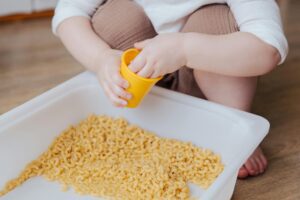
This is the easiest bin in existence. Grab a box of dry pasta; the shapes matter more than the type. Rotini, penne, and bow-ties are all great.
How to set it up:
- Pour dry pasta into a shallow tub.
- Add a few measuring cups and a funnel.
- Toss in some small plastic animals or cars.
The Twist: If you have a toddler who loves to sort, give them a muffin tin and ask them to put the “curvy pasta” in one hole and the “straight pasta” in another. It turns a sensory experience into a basic math and sorting lesson without you having to “teach” anything.
2. The “Arctic Blast” Ice Bin
Perfect for those hot afternoons or just when you need something that feels different. Water and ice are basic, but they provide a huge sensory contrast.
How to set it up:
- Fill a bin with water.
- Drop in a handful of ice cubes.
- Add blue food coloring (optional) if you want it to look like the ocean.
- Add “sea creatures” (plastic fish, whales, or even just blue Lego bricks).
The Twist: Freeze some of the small toys inside larger chunks of ice. Give your toddler a spray bottle with warm water or a kid-safe dropper to “rescue” the animals from the ice. This can keep a toddler occupied for an unusually long time because they are focused on the “mission.”
3. The “Kitchen Garden” Dirt Bin
If you don’t mind a little bit of actual dirt in your house (or you can use crushed-up brown crackers/cereal as a substitute), this is a winner.
How to set it up:
- Fill the bin with potting soil or dried black beans.
- Add small plastic shovels or spoons.
- Tuck in some artificial flowers or real twigs and leaves from the backyard.
- Add plastic bugs (spiders, beetles, worms).
The Twist: Give them a few small pots and some seeds (even if they aren’t real seeds, just beans). Let them “plant” their garden. This is a great way to talk about how plants grow while they’re just digging in the dirt.
4. The “Cloudy Day” Shaving Cream Bin
This is a “high-sensory” bin. It’s messy, but the cleanup is incredibly fast because it’s just soap.
How to set it up:
- Spray a thick layer of shaving cream (the foam kind, not the gel) across a baking sheet or the bottom of the tub.
- Give them a few paintbrushes or just their fingers.
- Add some colorful pom-poms or beads.
The Twist: Use the shaving cream as a “canvas.” Show them how to draw a circle or a line with their finger. If you have a toddler who is starting to recognize letters, you can draw a letter and ask them to “erase” it.
5. The “Construction Site” Corn Bin
Dried corn kernels are fantastic because they have a distinct sound and a slightly different texture than rice.
How to set it up:
- Fill the bin with dried corn.
- Add a few toy dump trucks, excavators, or bulldozers.
- Add some small stones or pebbles.
The Twist: Create “zones.” Put a small bowl of pebbles on one side and an empty bowl on the other. The goal is to use the trucks to move all the “rocks” from the quarry to the construction site.
6. The “Bubbles and Bath” Water Bin
While a bath is great, a dedicated water bin on the floor (put a towel underneath!) feels like a special event.
How to set it up:
- Fill a bin with warm water and a generous squirt of bubble bath or dish soap.
- Add a whisk, a sponge, and a few plastic cups.
- Add some “washable” toys, like plastic dinosaurs or cars.
The Twist: Tell them the dinosaurs are “dirty” and need a spa day. Give them a toothbrush or a small scrub brush to clean every nook and cranny of the toy. Toddlers love “helping” with chores, so framing it as “cleaning” makes it more engaging.
7. The “Autumn Wind” Leaf Bin
You don’t even have to go to the store for this one; you just have to step outside.
How to set it up:
- Collect a big pile of dried leaves, twigs, and acorns.
- Dump them into a bin.
- Add some “forest animals” (plastic deer, squirrels, or bears).
- Add a handheld broom or a small rake if you have one.
The Twist: Hide a few “treasures” (like shiny coins or colorful buttons) at the bottom of the leaves and have them hunt for the hidden items. It’s a tactile experience that also builds patience.
8. The “Rainy Day” Oatmeal Bin
Oatmeal is a great alternative to rice or beans because it’s softer and often safer if you have a toddler who still puts everything in their mouth (though supervision is always a must).
How to set it up:
- Fill the bin with plain, dry rolled oats.
- Add some cinnamon or a drop of vanilla extract to make it smell good.
- Add some scoops and small bowls.
The Twist: Add some “hidden” objects that are roughly the same color as the oats, like tan-colored buttons or wooden beads. The challenge is to find the objects by feel alone.
9. The “Cosmic Space” Rice Bin
If you have a bag of white rice, you’re halfway there. You don’t need to dye it purple or black to make it “space-themed.”
How to set it up:
- Fill the bin with white rice (the “stars”).
- Add aluminum foil balls (the “asteroids”).
- Add a few toy rockets, astronauts, or silver-colored blocks.
The Twist: Use a flashlight. Turn off the main lights and let the toddler use the flashlight to “navigate” through the stars and asteroids. It adds a visual element that changes the whole mood of the play.
10. The “Ocean Rescue” Water Beads Bin
Note: Use these only with older toddlers who no longer mouth toys, as water beads can be a choking hazard.
How to set it up:
- Hydrate some blue water beads in a bin.
- Add small fish, shells, and pieces of sea glass.
- Provide a slotted spoon or a strainer.
The Twist: Tell them the sea creatures are trapped in the “bubbles” and they need to use the strainer to rescue them and move them to a “safe harbor” (a separate bowl).
11. The “Rainbow” Pom-Pom Bin
This is the cleanest of all the bins. No spills, no stains, just softness.
How to set it up:
- Fill a bin with multicolored craft pom-poms.
- Add a pair of plastic tongs or a large spoon.
- Provide several bowls of different colors.
The Twist: This is the ultimate sorting game. Ask them to find all the red pom-poms and put them in the red bowl. If they’re older, you can give them “orders,” like “Give me three blue pom-poms and one yellow one.”
12. The “Magic Potion” Vinegar and Soda Bin
This is the only “science” bin on the list, and it’s a crowd-pleaser because of the fizz.
How to set it up:
- Put a layer of baking soda at the bottom of a bin or in several small cups.
- In a separate small pitcher, give them white vinegar.
- Add food coloring to the vinegar for a “magic” effect.
The Twist: Give them a dropper or a small spoon. Let them drop the vinegar onto the baking soda and watch the eruption. It’s an introductory lesson in chemistry that looks like magic to a two-year-old.
How to Manage the Mess (Because We Know You’re Worried)
Let’s be honest: the reason most parents avoid sensory bins is that they envision rice embedded in their carpet for the next three years. I get it. I’ve lived through the “Great Rice Spill of 2022.” But there are ways to make this manageable.
The “containment” strategy
Instead of worrying about the mess, change the environment.
- The Tablecloth Trick: Spread a cheap plastic shower curtain liner or an old bedsheet under the bin. When the play session is over, you don’t vacuum; you just gather the corners of the sheet and shake it out outside.
- The High Chair Method: If your toddler is still small enough for a high chair, use the tray. It’s a built-in containment system.
- The “Outdoor Only” Rule: If you have a porch or a yard, take the bin outside. The wind will take care of half the cleanup for you.
The “Clean-Up as a Game” Approach
Toddlers love to feel helpful. Instead of sighing loudly while you pick up beans, turn it into a game.
- “The Vacuum Monster”: Tell them the vacuum is a monster that loves to eat fallen rice. Let them help you “feed” the monster (while you hold the vacuum, of course).
- The Treasure Hunt: If something spills, tell them there are “lost treasures” on the floor, and they need to find them all and put them back in the bin.
Choosing the Right Base for Your Stress Level
Not all bases are created equal. If you’re feeling particularly overwhelmed, choose a “Low-Mess” base.
- Low Mess: Pom-poms, large pasta, water (in the tub).
- Medium Mess: Rice, corn, oatmeal.
- High Mess: Shaving cream, soil, water beads, baking soda/vinegar.
If you’re in “survival mode,” stick to the Low-Mess options. There is no prize for making your house a disaster zone in the name of “enrichment.”
Expanding the Play: How to Keep Them Engaged Longer
Sometimes a toddler will play with a bin for an hour; other times, they’ll lose interest in forty-five seconds. If you see them starting to wander, try these “intervention” strategies to extend the play.
1. Introduce a “Mission.”
Instead of just “playing,” give them a goal.
- “Can you find the hidden blue stone?”
- “Can you move all the corn from this bowl to that one?”
- “Can you build a tower of pasta?”
2. Add a New Tool Mid-Way
When the interest dips, introduce a new object. If they’re bored with the rice bin, bring over a colander. Suddenly, they have a new way to interact with the material, straining and sifting, which restarts the curiosity cycle.
3. Narrate the Experience
Your voice is a huge part of the engagement. Instead of just watching, describe what you see. “Oh! You found the dinosaur! Is he swimming in the ice? He looks cold!” This encourages them to think about the play and often gives them ideas for what to do next.
4. Rotate the Bins
Don’t give them access to every bin every day. If you have three or four “bases” (like a rice bin, a corn bin, and a pom-pom bin), keep them in separate containers and rotate them. A bin they haven’t seen in two weeks feels like a brand-new toy.
Common Mistakes Parents Make with Sensory Bins
Even with something as simple as a bin of beans, there are a few pitfalls to avoid. I’ve made all of these, so consider this your “skip the struggle” guide.
Overcrowding the Bin
It’s tempting to throw in every toy you own to make it “exciting.” But too many items can actually be overstimulating. A toddler might get overwhelmed and just dump everything out instead of playing. Stick to 3-5 key toys per bin.
Forgetting the Supervision
This sounds obvious, but it’s easy to think, “They’re just playing with rice, I can go check my email for five minutes.” This is when the rice ends up in the DVD player or the dog’s water bowl. Sensory play is an active engagement. You don’t have to be directing every move, but you need to be in the room.
Setting the Bar Too High
Don’t feel pressured to make these “Instagram-worthy.” Your child does not care if the rice is dyed a specific shade of teal. They care that they can pour something and watch it fall. The value is in the experience, not the aesthetic.
Ignoring the “Ending”
If you just snatch the bin away when it’s time for lunch, you’re inviting a meltdown. Give them a five-minute warning. “In five minutes, the dinosaur is going to go to sleep, and we’re going to clean up the bin.” This helps them transition their brain from “discovery mode” to “routine mode.”
A Comparison of Sensory Bases: Which One Should You Choose?
Depending on your goals—whether it’s calming them down, waking them up, or teaching a skill, different bases work better.
| Base Material | Sensory Type | Mess Level | Best For… | Prep Time |
| :— | :— | :— | :— | :— |
| Dry Pasta | Tactile/Auditory | Low | Sorting & Pouring | 1 Minute |
| Water/Ice | Thermal/Tactile | Medium | Cooling down/Discovery | 2 Minutes |
| Shaving Cream | Tactile/Visual | High | Creative drawing/Calming | 1 Minute |
| Dry Corn | Tactile/Auditory | Medium | Construction/Motor skills | 1 Minute |
| Potting Soil | Tactile/Olfactory | High | Nature exploration | 3 Minutes |
| Pom-Poms | Tactile | Very Low | Color recognition/Sorting | 1 Minute |
| Oatmeal | Tactile | Medium | Soft textures/Safe exploration | 1 Minute |
| Water Beads | Tactile/Visual | Medium | Visual focus/Fine motor | 5 Minutes |
How Mom Creative Blogger Supports Your Parenting Journey
If you’ve read this far, you’re likely a parent who wants the best for their child but is also feeling the weight of the daily grind. Whether you’re a stay-at-home mom feeling the isolation of the “toddler years” or a working mom trying to squeeze in quality play during a short window of time, you aren’t alone.
At Mom Creative Blogger, we believe that parenting doesn’t have to be a performance. You don’t have to have the most aesthetic playroom or the most curated activities to be a great parent. Sometimes, “great parenting” is just finding a way to keep your toddler occupied with a tub of pasta so you can take a deep breath and remember who you are outside of being “Mom.”
We focus on the real stuff: the burnout, the ADHD struggles, the “what do I do with my kids today” panic, and the honest truth about the mental health toll of motherhood. We provide practical resources from printables to activity guides designed for the mom who has five minutes of prep time and a toddler who has infinite energy.
If you’re looking for a community that validates your struggles instead of pretending they don’t exist, you’re in the right place. We’re all just fellow travelers here, trying to figure it out one sensory bin at a time.
Final Takeaways for Your Low-Prep Sensory Play
If you’re feeling overwhelmed, don’t try to do all 12 of these today. Just pick one.
- Start Small: Grab a plastic tub and some dry pasta. That’s it.
- Prioritize Your Peace: Choose the base that matches your current energy level. If you’re exhausted, go with pom-poms.
- Embrace the Mess: Use a sheet or a towel. The cleanup is a small price to pay for a quiet toddler.
- Follow the Child: Let them lead the play. If they want to use the “construction corn” to feed a plastic dinosaur, let them. The creativity is where the learning happens.
You’ve got this. Your toddler doesn’t need a Pinterest-perfect childhood; they just need a parent who is present, and a few things to pour from one bowl to another. Go grab that tub of rice and reclaim your afternoon.